
Portugal D2 vs D7 Visa: 2026 Alternatives to Golden Visa
The immigration and investment landscape in Portugal has changed drastically in 2026. With the end of the real estate “Golden Visa” and the disappearance of “easy tax arbitrage,” investors face a stricter reality. If you intend to relocate your capital or your family, the choice often comes down to the Portugal D2 vs D7 Visa. Understanding the nuances between these two paths is critical, especially now that the NHR (Non-Habitual Resident) regime has been replaced by the restrictive IFICI program.
Table of Contents
The End of the Real Estate Golden Visa
For over a decade, the Golden Visa was the primary route for non-EU investors. However, the “Mais Habitação” (More Housing) package and the State Budget updates have consolidated a new paradigm focused on regulation and corporate capitalization.
Today, purchasing residential or commercial real estate no longer qualifies for the Golden Visa. Although the program still exists, the focus has shifted radically. The most sought-after route is now through Investment and Venture Capital Funds.
How does this current program work? It requires a minimum investment of €500K in these funds. The capital is directed to support Portuguese small and medium-sized enterprises (SMEs) with high growth potential in strategic sectors such as technology, renewable energy, healthcare, and agriculture. The current golden rule is clear: these funds cannot have any exposure, direct or indirect, to the real estate market. (Other active Golden Visa options include donations of €250K for cultural heritage, €500k for scientific research, or the creation of 10 direct jobs).
Due to the lack of tangible real estate assets and the lock-up periods of these funds, many investors are turning to residency permits that require a stronger connection to the country. This is where the comparative analysis between the Portugal D2 vs D7 Visa comes into play.
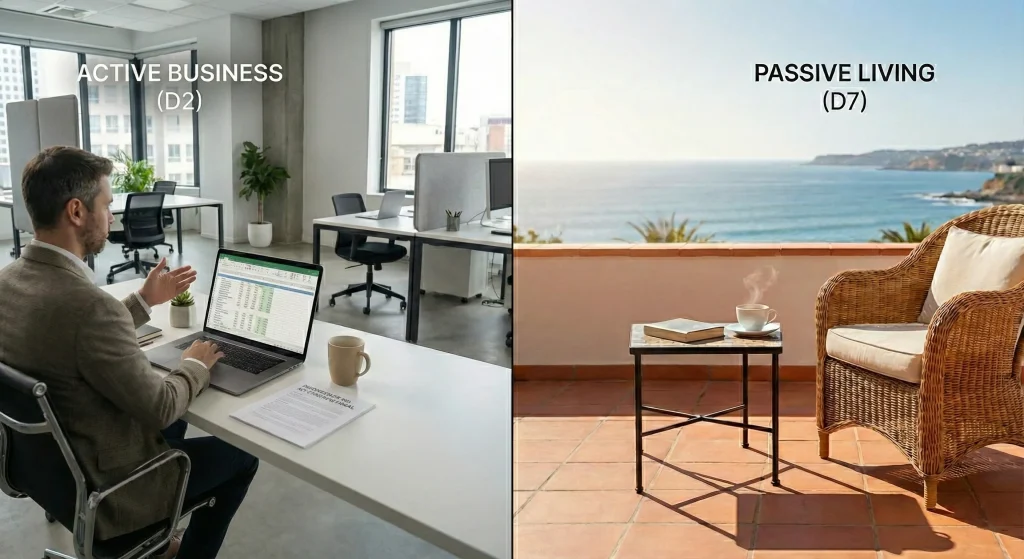
Portugal D2 vs D7 Visa: Which suits your profile?
The fundamental difference lies in the nature of your activity: active vs. passive.
The D2 Visa: For the Entrepreneur (Active)
The D2 Visa is the “Immigrant Entrepreneur” route. It is ideal for those who intend to run a business in Portugal, open a branch of their company, or work as an independent professional with local operations. In 2026, this is often the most coherent path for investors who previously bought properties for income and now prefer to invest their capital in a value-generating activity.
This visa requires “substance,” which translates into the obligation to present a solid Business Plan.
Where to get more information? The website of IAPMEI (Agency for Competitiveness and Innovation) provides guides, support tools, and structural templates for drafting business plans. Given the 2026 requirements, it is highly advisable to consult corporate immigration lawyers to bulletproof your application.
What plan is this? It is a formal financial and strategic document. It must include a market study, financial projections (typically 3 to 5 years), proof of economic viability, sufficient share capital for the initial operation, and, ideally, an estimate of the impact on the local economy or job creation.
Where to submit? The process must be initiated at the Portuguese Consulate in your current country of residence. If you are already legally in the national territory, the process is handled by AIMA (the Agency for Integration, Migration, and Asylum).
The D7 Visa: For the Retiree (Passive)
The D7 Visa is designed for individuals with stable and guaranteed long-term passive income (pensions, dividends, royalties, or foreign rental income). With the National Minimum Wage constantly rising (set around €920/month in 2026), the financial entry requirements have tightened (proof of this monthly passive income is required, plus percentages for each dependent family member).
When evaluating the Portugal D2 vs D7 Visa, remember that the D7 does not allow the same flexibility for active management of investment projects and local business creation that the D2 offers, as it is strictly focused on a “living off yields” lifestyle.
Key Differences at a Glance
Below is a breakdown of the requirements for the Portugal D2 vs D7 Visa in the current legislative context.
| Feature | D2 Visa (Entrepreneur) | D7 Visa (Passive Income) |
| Profile / Main Goal | Entrepreneurs, freelancers, and investors seeking active engagement. | Retirees, landlords, and individuals living off yields (rentiers). |
| Financial Requirement / Investment | Company incorporation, adequate share capital, and a viable Business Plan. | Proof of regular and continuous passive income (> €920/month). |
| Professional Freedom | Focused on managing your own company or independent activity in PT. | Free to live off income; allows working in PT if desired, but approval is based on passive income. |
| Presence Requirement (Stay) | General rule: minimum of 6 consecutive months or 8 interpolated months per year. | General rule: minimum of 6 consecutive months or 8 interpolated months per year. |
| Path to Citizenship | Eligible for a Portuguese passport after 5 years of legal residency. | Eligible for a Portuguese passport after 5 years of legal residency. |
Property Purchase and the D2 and D7 Visas: The Strategic Link
As a Strategic Real Estate Consultant, the question I hear most is: “If buying a house no longer grants me the Golden Visa, why should I buy a property during the Portugal D2 vs D7 Visa process?”
The answer is simple: buying a property has gone from an entry ticket to a cornerstone of your immigration process. Here are the reasons why purchasing a property directly benefits your chances of approval:
- Irrefutable Proof of Accommodation (The AIMA Factor): To approve either of these visas, the Portuguese State requires proof that you have a place to live. Presenting a deed or a Promissory Purchase and Sale Agreement (CPCV) demonstrates a level of financial commitment and roots in the country that accelerates and shields the visa approval, far surpassing the fragility of a rental contract. This is exactly why hiring a real estate agency with strategic expertise is crucial to secure the right property before you even arrive.
- Synergy with the D7 Visa: If your plan is the D7, purchasing your own home in Portugal eliminates the monthly rental expense (which is at historic highs), optimizing the profitability of your capital. Additionally, if you own properties in your home country and rent them out, those rents actively count as the “passive income” required by the consulate.
- The “Substance” of the D2 Visa: In the case of the entrepreneur visa, acquiring a property—whether a commercial space for your company’s physical headquarters or a mixed-use property—proves the “substance” of your Business Plan to IAPMEI and AIMA. It shows that you are not opening a “shell” company but injecting real capital and infrastructure into the Portuguese economy.
The Tax Reality: NHR vs. IFICI
When choosing between the Portugal D2 vs D7 Visa, you must consider the current heavy tax implications. The old and famous NHR (Non-Habitual Resident) regime has been closed to new applicants. In its place, the Government implemented the IFICI – Tax Incentive for Scientific Research and Innovation (often referred to as “NHR 2.0”).
What is IFICI, and what does it mean? IFICI is a highly restrictive program designed to attract brains, talent, and corporate investment, not just lifestyle capital. It offers a special IRS (personal income tax) flat rate of 20% (on Category A and B employment income) and exemptions on most foreign-sourced income (except pensions, which lost the previous benefit) for 10 years.
However, eligibility is the main filter. To access IFICI, you must be:
- A higher education professor or scientific researcher;
- A highly qualified professional in a project recognized by entities such as AICEP (Agency for Investment and Foreign Trade) or IAPMEI;
- A manager or board member of a certified tech Startup.
The Real Cost of Inaction: Consider the financial impact of the new tax landscape. If you come on a D7 Visa and invoice abroad without the NHR or IFICI framework, a €100k income is now fully exposed to the standard progressive brackets of the Portuguese IRS. Without a customized corporate structure (which a D2 Visa could provide), you could see up to 48% of your global income handed over to the State. This is not just a tax increase; it is an erosion of your ROI that requires planning with a tax lawyer and a Strategic Consultant.
Conclusion
Navigating the decision of the Portugal D2 vs D7 Visa in 2026 requires professional planning. Whether you choose the entrepreneurial freedom of the D2 or the passive stability of the D7, ensure that your transition and real estate acquisition strategy is perfectly aligned with the country’s new, and much more demanding, tax (IFICI) and legal reality.