
How to Build a Motivated Team Without Superpowers
Explore Maintenance and Motivator factors, plus job characteristics, to build a motivated, productive, and loyal team.
For a long time, I felt the urge to start writing, but my life as the owner of a small company consumed all my time and drained my inspiration. Around the middle of 2023, my life took a complete turn. The technology sector suffered a massive crash, and my company was no exception.
Suddenly, I ran out of customers and, consequently, of money, leaving me with no choice but to let my team go. It was a difficult period — having to make that decision and personally explain the situation to each team member. Watching everything I had built over 12 years vanish in just a few months was devastating.
Fortunately, as time passed, things began to settle. Step by step, I started closing chapters until I found some peace of mind, managing to live a simpler life while earning a modest income from small 3D projects for regular clients.

Now, with more free time, a greater desire to learn new things, and space to reflect on my past, I’ve come to realize how successful I truly was, even though I didn’t feel it at the time. I developed 3D web-based configurators for furniture — chairs, tables, shelving systems, and sectional sofas — while travelling to Copenhagen and Stockholm to secure clients and discuss ideas.
I ended up working with 10 of the most renowned Scandinavian furniture brands, building strong relationships and earning their trust. Through recent networking and conversations with other technology professionals, I’ve come to appreciate how remarkable it was that a team of just four people could develop such complex configurators. I can’t help but feel proud of myself and everyone who spent eight hours a day working alongside me.
My awareness of these accomplishments sparked new curiosities in me: How did I manage to develop such configurators with a team of just four? Why did my employees enjoy working with me? And why was employee turnover so low over 12 years?
Maybe I have a natural talent for leading people, but I don’t have any extraordinary superpowers. After some internet research, I came across Herzberg’s Two-Factor Theory from 1959. He divided workplace factors into two main groups: maintenance factors, which only reduce negative attitudes and dissatisfaction, and motivator factors, which foster positive attitudes and keep employees engaged.
The Maintenance Factors
These factors must be covered before you can move to motivational factors:
- Job security
- Recognised and maintained Status
- Interpersonal relations: No conflict or humiliation with peers, superiors, and subordinates.
- Personal Life balanced: Management must be aware of this aspect.
- Appropriate and reasonable Salary
- Physical working conditions
- Equipment: Should be modern and well-maintained.
- Supervision: The employee fits into the company’s overall plan.
- Company policies: Not too rigid, fair, and clear.
- Flexible working hours: Breaks, vacations, remote/hybrid job (this is my new one).
- Culture: Respect and dignity for all members.
The Motivator Factors
Once the foundation is set, these factors create a feeling of accomplishment:
- Growth opportunities: Professional and personal development.
- Advancement opportunities: As a manager, be aware of factors that drive growth and advancement. (Note: Not all employees want to advance to a higher level).
- Responsibility: The employee must be held responsible for their work. The manager should give them ownership, minimising control but retaining accountability.
- Meaningfulness of the work: The work must be meaningful, interesting, and challenging.
- Recognition: The employee should be praised and recognised for their accomplishments.
- Sense of achievement: Job success by effort, courage, or skill.
Having a very small team greatly contributed to my achievements, as it helped fulfil almost every maintenance and motivator factor. But my curiosity didn’t end there.
As I researched further, I discovered more relevant information to explore. While I now understand job factors, I wonder about the characteristics that drive motivation. This led me to Richard Hackman and Greg Oldham’s 1975 research on job characteristics that influence psychological states and ultimately affect personal and work outcomes.
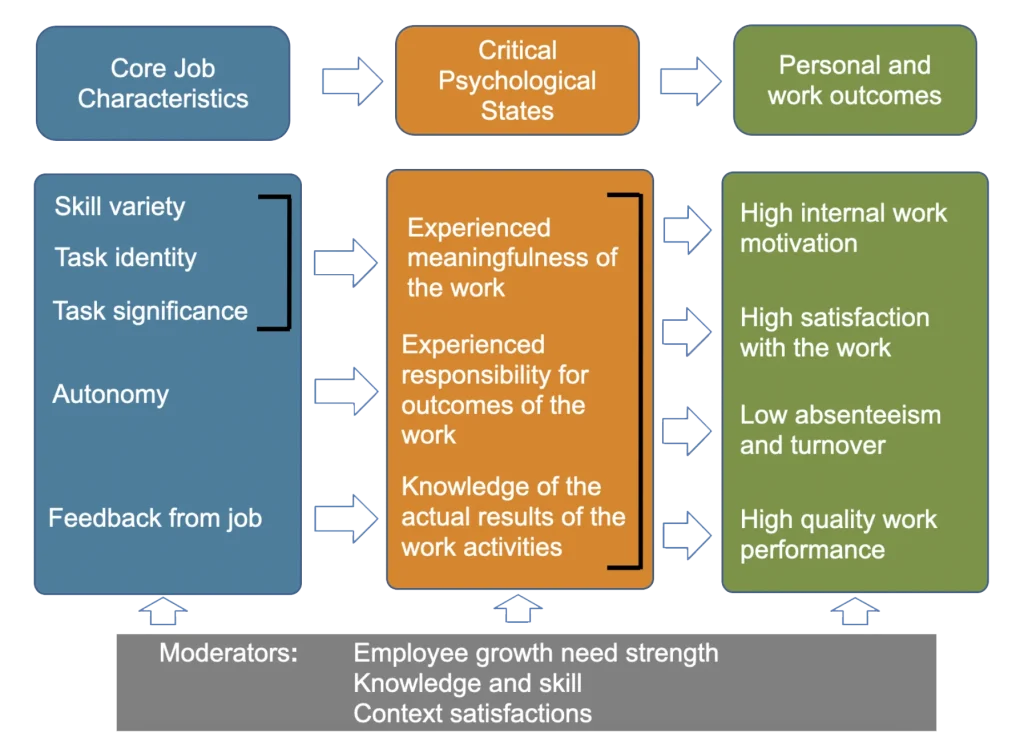
Core Job Characteristics
How the job is structured for the individual employee:
- Skill Variety: Engaging multiple skills and talents in a job enhances interest, fulfilment, and a sense of competence.
- Task Identity: Completing a whole task, an identifiable piece of work, provides a sense of accomplishment. From start to finish with a visible outcome.
- Task Significance: Recognizing the job’s impact on others increases its meaningfulness, the importance of their careers to the organisation or society.
- Autonomy: Having control over work decisions and determining procedures encourages responsibility, motivation, and freedom.
- Feedback: Clear information about performance helps employees understand their effectiveness. It can be provided by the job itself or by management.
These dimensions contribute to three critical psychological states:
- Experienced Meaningfulness: Feeling that work is worthwhile.
- Experienced Responsibility: Being accountable for work outcomes.
- Knowledge of Results: Understanding how well one is performing.
When these states are present, employees show higher motivation and satisfaction, lower absenteeism, and higher performance.
Conclusion
Keep these principles in mind: you don’t need extraordinary skills or superpowers to build motivated and engaged teams.
What you do need is a thoughtful approach to organizing work and matching the right person to the right task. By structuring jobs to enhance core characteristics such as autonomy, feedback, and task significance, you can create an environment where employees thrive.
One job characteristic, in particular, stands out: feedback. It not only drives motivation but also fosters communication, which is essential for building trust and ensuring workplace safety.
In the next article, we’ll dive deeper into the role of feedback and how it can transform team dynamics. For now, take a moment to reflect on these principles and consider how you can apply them to your team or workplace. With the right mindset and approach, you can create a culture where people feel valued, motivated, and inspired to do their best work.
Just wonderful!! … not that complicated. Thank you!!
🙂 Thank you